
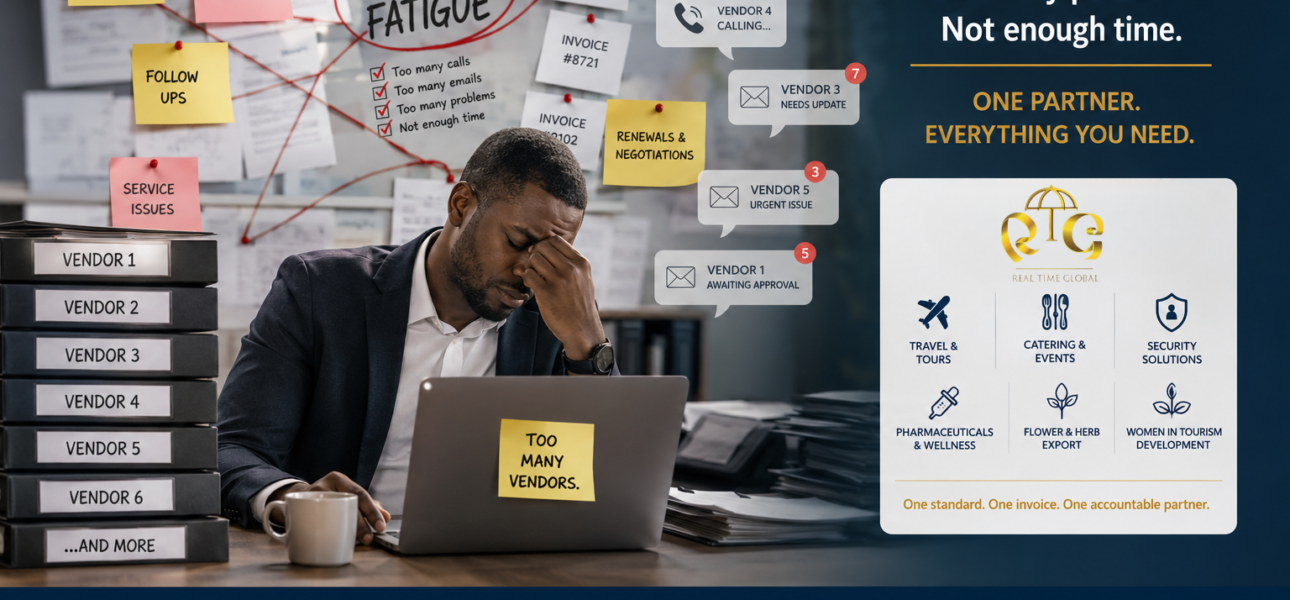
The hidden cost of managing too many vendors and why Kenya’s leading organizations are choosing a different model.
Here is a question no one in your finance team wants to answer on a Monday morning:
How many vendors does your business actually manage and what is the real cost of each one?
Most organizations, when they sit down and count, are surprised. Not just by the number but by what that number is quietly costing them. In time. In money. In management bandwidth that could have gone elsewhere.
This is not a theoretical concern. It is one of the most underreported operational challenges facing businesses across Nairobi and East Africa today. And a growing number of the region’s most strategic leaders are doing something about it.
The Problem Has a Name: Vendor Fatigue
Vendor fatigue is what happens when a business grows and, with it, the web of suppliers, service providers, and contractors it depends on. At five vendors, it is manageable. At ten, it is a part-time job. At fifteen or more which is more common than most organizations admit it becomes a structural drag on the entire business.
Consider what managing even six separate service providers actually involves:
- Six different onboarding processes, contracts, and due-diligence cycles
- Six invoice streams to reconcile every month
- Six points of contact to manage when something goes wrong
- Six different service standards some excellent, some not
- Six renewal cycles, price renegotiations, and relationship management conversations
Research from global procurement consultancies consistently shows that organisations with fragmented supplier bases spend between 12 and 18 hours per department per month on vendor administration alone. That is time that is not going to strategy, clients, or growth.
The numbers behind vendor fragmentation
- 30% of procurement admin time spent managing supplier relationships, not outcomes
- 6–12 average number of service vendors a mid-size Nairobi business manages
- 15–30% potential cost reduction when consolidating to an integrated service partner.
- 3× faster crisis resolution when a single partner manages multiple service lines
What Vendor Consolidation Actually Looks Like in Practice
When organizations talk about consolidating their service providers, the conversation often stalls at the theoretical. ‘It sounds good in principle, but we have different needs across departments.’ ‘Our travel is handled separately from our security.’ ‘We have always used different caterers for different events.’
These are reasonable objections but they rest on an assumption that is no longer as true as it used to be: that no single partner can provide breadth without sacrificing depth.
The integrated solutions model challenges that assumption directly. Rather than one generalist trying to do everything poorly, it brings together specialist capabilities under a single operational umbrella with consistent service standards, unified account management, and the kind of institutional knowledge that only comes from a partner who knows your business across multiple functions.
The best procurement decisions are not just about cost. They are about control, consistency, and the confidence that the right people will be there when you need them.
Side by side: Fragmented vendors vs. an integrated partner
Business Challenge | Multiple Vendors | RTG — One Partner |
Monthly admin time | 12–18 hrs per dept | 2–4 hrs per dept |
Number of contacts | 6–12 separate vendors | 1 account manager |
Invoice processing | 6–12 invoices/month | 1 consolidated invoice |
Service standard | Varies by vendor | Consistent across all |
Crisis response | Multiple calls, delays | Single point, immediate |
Avg. cost savings | Baseline | 15–30% reduction |
The Real Time Global Difference: Built for This Exact Problem
Real Time Group Global was not built by combining unrelated businesses. It was built by identifying the full range of services that any serious Kenyan organization needs to function well and bringing them under one roof, to one standard.
Today, RTG’s six subsidiaries cover the primary operational service needs of businesses across every sector:
- For corporate and leisure travel we have Real Time Tours & Travel
- For catering for events, meetings, and daily operations, Real Time Restaurant & Outside Catering handles this.
- For Pharmaceutical and corporate wellness; Real Time Pharmaceuticals
- For Home, Site and event security, Real Time Fast Response Security becomes your to-go-to.
- For Premium fresh flower and herb export White Square Company Limited delivers.
- For Women’s leadership development in tourism, Women in Tourism Africa (WITA) is the anchor.
The proposition is straightforward: instead of six service standards, one consistently applied across every engagement.
And when something goes wrong when a travel booking needs to change at midnight before a board trip, when a catering delivery hits a snag two hours before a product launch, when a security concern arises during an event there is one call to make. One partner who knows your business, your standards, and your expectations.
This is not convenience for its own sake. It is a strategic advantage and the organizations that have moved to this model are not going back.
What Nairobi’s Leading Organizations Are Getting Right
The shift toward integrated service partnerships is not a trend. It is a strategic maturation and it is being led by the businesses that understand that operational efficiency is a competitive advantage, not just an accounting exercise.
The most forward-thinking organizations in Kenya are asking a different question. Not ‘who is the cheapest option for each service?’ but ‘who is the best partner for our overall operational needs?’ The distinction is significant. It moves procurement from a transactional function to a strategic one — and it fundamentally changes the kind of relationships organizations build with their service providers.
Those relationships, when built well, deliver something that no individual vendor can: institutional knowledge. A partner who understands how your business works, what your standards are, and what it means when you say you need something done properly. That understanding cannot be invoiced. But it has an enormous value.
Is Your Business Ready to Make the Move?
If you are managing more than four or five service providers for your core operational needs, it is worth asking whether the current model is serving you as well as it could be. Here are the questions that typically surface when organizations do this audit:
- How much time does your team spend on vendor administration each month?
- Are your service standards consistent across providers or are you getting excellence from some and mediocrity from others?
- When something goes wrong, how quickly can you get a resolution and how many calls does it take?
- What would your operations team do with 30–40% of their vendor management time back?
- Does your current supplier base know your business well enough to anticipate problems before they happen?
If any of these questions landed harder than expected, the integrated solutions model deserves a serious look.
The Business Case, in Plain Terms
Less time managing vendors means more time building your business. Fewer invoices means more clarity in your financial planning. A single, consistent service standard means fewer surprises and fewer conversations that begin with ‘this was not what we agreed.’
Real Time Global was built on the conviction that global businesses and organizations more broadly deserve a service partner that meets them where they are, covers what they need, and shows up with the same quality and commitment every time.
That is what we are here for. And we are there when you need us.
Ready to consolidate? Talk to us.
Find out how Real Time Global can serve as your single integrated partner across travel, catering, security, pharmaceuticals, and more.
Email: info@realtimegroup.co.ke | Tel: +254 204 404 243 | Web: realtimegroup.co.ke